|
|
|
|
||||||||
|
|
|
|
Pluralism, otherwise known as single member voting, first-past-the-post, majoritarian voting, or in Australia, the rather confusing designation of ‘preferential voting’, is the electoral system whereby all the people living in a specific geographical area will end up being represented by just one candidate despite the fact they may well embrace quite divergent political beliefs. |
|
||||||||||
|
||||||||||
|
|
|
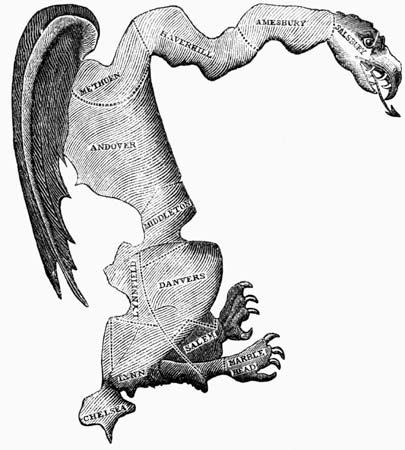
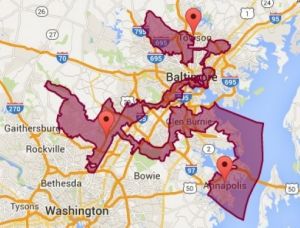
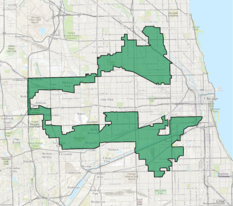
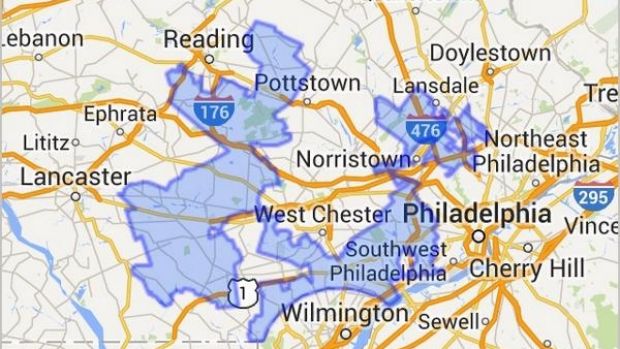
Problems The Gerrymander |
|
|
|
"Gerrymandering is one of the great political curses of our single-member district plurality system." |
|
||||||||||||||||||||||||||||||||||||||||||||||||||
|
||||||||||||||||||||||||||||||||||||||||||||||||||
|
|
|
“in U.S. politics, drawing the boundaries of electoral districts in a way that gives one party an unfair advantage over its rivals. The term is derived from the name of Governor Elbridge Gerry of Massachusetts, whose administration enacted a law in 1812 defining new state senatorial districts. The law consolidated the Federalist Party vote in a few districts and thus gave disproportionate representation to Democratic-Republicans. The outline of one of these districts was thought to resemble a salamander. A satirical cartoon by Elkanah Tisdale appeared in the Boston Gazette; it graphically transformed the districts into a fabulous animal, “The Gerry-mander,” fixing the term in the popular imagination.” "gerrymandering." Encyclopaedia Britannica 2008 Ultimate Reference Suite In the above table, representing an election of just five districts, it can be seen that the Labour Party has won owing to winning the majority of seats, despite the fact they gained fewer votes. |
|
|
||||||||||||||||||||||||||||||||||||||||||||||||||||||||||||||||||||||||||
|
|
Redistricting aka RedistributionNo cunning politician can engineer (or arrange to have engineered) a gerrymander without first a required redistricting of electorate/ district/ seat boundaries. This is required, and mandated, in most democracies to prevent that other electoral problem, malapportionment.Unfortunately this necessary evil of redistricting not only permits the gerrymander to happen but also opens the door to other electoral abuses where incumbent parties can cause problems for opposition supporters and their representatives. Redistricting Glossary
“[Reforming the electoral system towards proportional representation] is not a radical proposal. It is practical and reasonable. Most importantly it would ensure that a party with a minority of the two-party vote never accidentally ‘won’ an election again-as the Howard government did last October. Howard enjoys a 12-seat majority in the House of Representatives having attracted only 48.7 per cent of the two-party preferred vote. If democracy can be defined as a situation wherein the will of the majority prevails, then Labor leader Kim Beazley should have formed government after the last election. Worse still, this outcome was not exceptional. In one in four Australian elections, the electoral system delivers government to the wrong party. It is worth noting that in other, less politically stable countries, similar outcomes have led to popular revolution.” Extract from Representation and Institutional Change, ‘Papers on Parliament No. 34’, December 1999, Department of the Senate, Canberra. pp116-117. |
|
|
||||||||||||||||||||
|
|
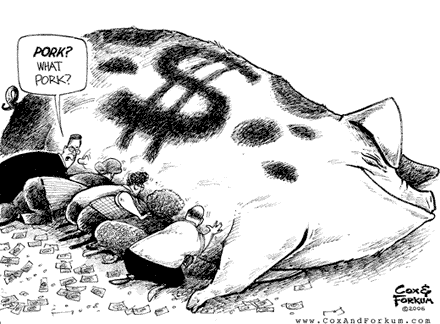
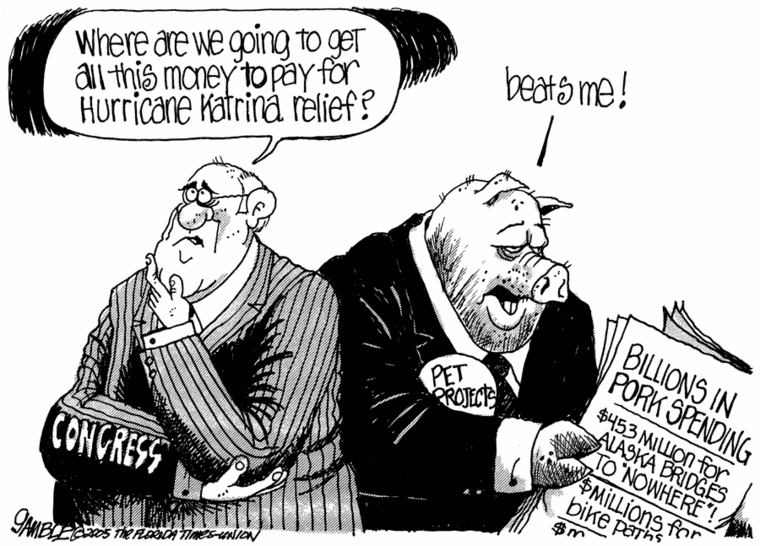
Typically [pork barrelling] involves funding for government programs whose economic or service benefits are concentrated in a particular area but whose costs are spread among all taxpayers. Public works projects and agricultural subsidies are the most commonly cited examples, but they do not exhaust the possibilities. Pork barrel spending is often allocated through last-minute additions to appropriation bills. A politician who supplies his or her constituents with considerable funding is said to be "bringing home the bacon." Wikipedia Pork Barrelling is the practice of members of a country’s S.M.V. legislature gaining special benefits for their own particular electorate so as to keep them in good grace with their constituents. Although technically not a bribe, it does border on the unethical because even though it is the duty of politicians to care for the welfare of the public, there does seem little justification to arrange benefits for just one segment of the population at the obvious expense of all others. Of course in theory it could also happen with proportional representation systems. Politicians will still have constituents whose vote they want at the next election even if they don’t all live in the same area. However in practice it would be a lot more difficult pass on a ‘gratuity’ to people when there is no pretext for giving it to them apart from the characteristic of the voters themselves. What justification can you have for legislation that grants money to people because they support environmental measures, or believe in capital punishment or believe that we should not be involved in foreign military entanglements?
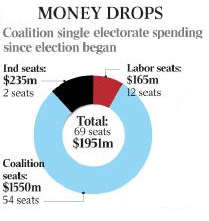
[Australian] Federal election 2016: Pork by Coalition ‘unprecedented’The Australian, 25th June 2016 David Uren, Economics Editor The Coalition is undertaking unprecedented “pork-barrelling” in an effort to shore up votes in its electorates and lure voters in marginal Labor seats. While the Coalition has avoided big spending promises such as Labor’s commitments to schools and hospitals, it is outspending Labor by more than four-to-one in individual electorates. The Coalition has promised to support 134 projects costing almost $2 billion across 68 federal electorates since the election campaign was called on May 8. The overwhelming majority of the funding has gone to Coalition-held seats, with 54 of its 90 seats winning local commitments totalling $1.6bn. Marginal Electorates Marginal electorates have received the most funding while frontbenchers … have also won local promises. The Coalition will spend just $159 million in 12 Labor-held seats but has committed $234m to road projects in seats held by independents Clive Palmer and Bob Katter. The Coalition will spend $70 million trying to retain the bellwether seat of Eden-Monaro for parliamentary secretary Peter Hendy, including $70,000 to get rid of fruit bats in Batemans Bay and funding for roads, ports, street lights and Merimbula airport. Greens leader Richard Di Natale attacked the use of taxpayers Labor is also making single-electorate promises, …[being] commitments of $470m in 25 seats, most of which are held with narrow margins by the Liberals. A Labor government would also give $800,000 to the Balmain Water Polo Club in [front-bencher] Anthony Albanese’s electorate of Grayndler.
|
|
|
|
|
|
|
|
Minimal RepresentationAt the Australian 2001 federal election for the House of Representatives there was a total of 11,474,074 citizens directing their first preference vote towards a large range of parties such as Liberal, Labor, the Nationals, Greens, One Nation as well as a number of independents. A count was done of the one hundred and fifty winning candidates totals, irrespective of party, to find out how many first preference votes each received. Even though a candidate needs more than his first preference votes to ultimately give him a majority in an electorate, if one were to add just these votes for all the successful candidates, it would give a figure of 5,663,816. This means that on election night throughout the country when the results were being broadcast, 5,663,816 viewers could feel satisfied knowing that even if their party might not have won government, they at least would end up with the local representative of their choice. However what the statistics also reveal is that a greater number, 5,810,235, wouldn’t. Thus the majority of the voters in the 2001 election (and, as it turned out, the 1998 election) ended up with a representative not of their first choice. There has to something seriously wrong with an electoral system when it is not rare for the average voter to be encumbered with a representative who was not his or her direct choice. |
||||||
|
The chief executive AND your local member One of the most bizarre aspects of pluralist voting when it is applied to responsible government systems, is the fact that someone as important as the prime minister also remains, because he or she is still a member of the lower house of parliament, the representative of the electorate from which he/she is based and is duty bound to be the one handling all local concerns. It seems incongruous that someone who may well be involved in strategically important discussions with world leaders about their united involvement in theatres of war, might also have to talk a call from a constituent complaining that the aircraft noise from above his farm is stopping his hens from laying. A party decapitated |
||||||
A two-party system often develops spontaneously from the single-member district plurality voting system (SMDP), in which legislative seats are awarded to the candidate with a plurality of the total votes within his or her constituency, rather than apportioning seats to each party based on the total votes gained in the entire set of constituencies. This trend develops out of the inherent qualities of the SMDP system that discourage the development of third parties and reward the two major parties. Duverger's law Wikipedia It is hard to understand why the advent of a political system that limits the number of political parties to only two should in any way be celebrated. Should voters feel privileged that they have only two viable options at election time? Are we to assume that so called third, or minority party supporters, are not concerned about the fact that they are destined to never achieve representation in SMV houses of parliament? And for Americans, still another problem Compared to democracies as, for example, Australia, where the prerequisite of an electorate or district is to contain a certain number of “people of the Commonwealth”, the United States Constitution mandates, in the 14th Amendment, that the limited number to make up a district is only of “persons in each state…wherin they reside”, but immaterial of whether they be citizens, long term overseas visitors, temporary foreign workers, or even illegal immigrants. The non-citizens may not be allowed to vote, but surprisingly they still influence determining how many representatives the citizens of each state may have. With America’s population currently at 326 million, and the number of House of Representatives’ seats being 435, the required number of “persons” needed to fill a congressional seat would be approximately 749,000. So, if a state, over time, has an influx of non-citizens numbering, for example, one and a half million, it would then be allowed to redraw its districts to include an extra two, even though the state’s voting citizens remain the same number. Politico Magazine, quoting American University scholar, Leonard Steinhorn, declared in 2015 that California, being a magnet for illegal immigrants, then had five more districts / congresspersons than their voting population would normally deserve∆. |
||||||
|
|
|
|
|
# With Australia’s preferential voting system for single member seats, ALL votes eventually end up with either of the two larger parties. This is because the voter must indicate on the ballot paper not only his primary choice but all preferences all the way down to his last choice. Thus in the so called ‘two party preferred’ final tally, votes from losing smaller parties will be distributed upwards towards the larger parties according to the actual preference on each individual ballot paper. § Technically, allowance is made in the Australian Constitution for procedures to attempt to bring ‘a winning leader without seat’ back into office. Section 64 allows the Prime Minister (as a Minister of State) to remain in his position for three months without being a member of Parliament. This would be sufficient time to arrange for a junior member of his own party to resign his seat and allow the Prime Minister to contest the subsequent by election. However, this is not a perfect solution. It is offensive to the people of the electorate to tell them that the person they have recently given their approval to, has now resigned and that they must again go to the trouble of voting to choose a representative. While the whole cost is an added drain on the state coffers, the new candidate obviously has no roots in the local community and there is still no guarantee that he will win. * Evan Williams, The Weekend Australian: Review, Nov 10, 2007, p.9 ∆ Goldman, Paul & Rozell, Mark, ‘Illegal Immigrants Could Elect Hillary’, Politico Magazine, 3/10/2015 |
|
|
| [Home] [Pluralism] [About Us] [FAQ] [Benefits] [Links] [Criticism] |








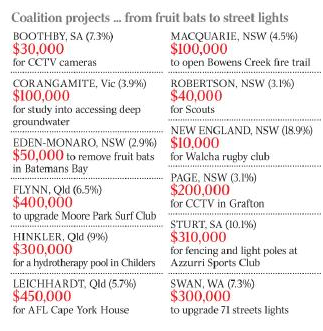 ’ funds to bolster electoral prospects in individual seats, saying: “You’d be forgiven for thinking you are seeing a contest for who will win a seat on the council of local government rather than who will become the next prime minister of this country.” Many Coalition projects are typical local government responsibilities: it will spend $3m upgrading pavements in the safe Nationals electorate of Calare in central NSW and $300,000 upgrading 71 light posts in the safe Liberal-held electorate of Swan in Western Australia. A Coalition government would pay for the installation of CCTV cameras in 12 of its electorates, while it would pay for four netball courts — three in its own electorates and one in the marginal Labor-held electorate of Moreton in Queensland.